
The ImaginePlus collection / 01 / For educators, faculty and subject matter experts
Imagination
Where possibility begins.
Every creative undertaking begins with a possibility that is not yet fully present. Explore the many ways people imagine, the cultural histories that give those possibilities meaning, and the responsibility institutions carry to preserve this capacity as tools and technologies change.
“Invention, it must be humbly admitted, does not consist in creating out of void, but out of chaos”

01 / An educational perspective
The internal mental sandbox
Before an idea can be shared, there is a possibility to consider: a scene not yet staged, a sound not yet heard, a different outcome, a feeling seeking form. Imagination is our internal mental sandbox. It allows us to entertain images, feelings, situations, and concepts beyond what is immediately present.
This sandbox need not be a vivid picture. A learner may begin with words, relationships, rhythm, movement, atmosphere, or an abstract possibility. Philosophical accounts distinguish imagination from belief and debate the relationship between imagination and mental imagery. That distinction matters in education: ease of visualizing should not become the measure of a person's imaginative worth. [H01]
Our teaching framework connects this inner activity with creativity, the work of developing ideas, and with art, the expression offered to others. These relationships are open to return journeys. A sound heard in rehearsal, a material held in the hand, a conversation, or an unfinished artwork can invite someone to imagine again. For educators, the value of the framework is a shared language for discussing that movement with patience and care. It makes room for a learner to explain where an idea began and how it changed, without treating the framework as a diagnostic test of the mind.
02 / Histories in conversation
A history with many centers
01
The engraved ocher from Blombos Cave in South Africa, dated by the Smithsonian to approximately 77,000–75,000 years ago, carries deliberately organized marks. Researchers debate what they communicated. It is evidence of patterned material activity, not a surviving transcript of an ancient person's imagination. This object invites curiosity without establishing a single birthplace of creativity. [H04]
02
The Ice Age Lion Man from what is now Germany combines human and animal features in carved ivory. Its form offers a way to discuss representing something beyond ordinary observation; its precise ancient meaning remains interpretive. The two examples invite comparison across places without ranking their cultures. [H05]
03
The Maya Vessel with mythological scene, dated 600–800 CE, organizes deities and narrative around a ceramic surface. The museum's interpretation concerns a specific Maya cosmology, not generic fantasy. This object raises a question: how does a society communicate relationships between the visible and invisible through material form? [H10]
04
In Australia's Western and Central Deserts, the Seven Sisters songlines are carried through living relationships among story, Country, performance, and custodianship. The National Museum's exhibition brings painting, objects, song, dance, and multimedia into dialogue. These are living knowledge traditions with their own authority; describing their expressive dimensions does not reduce them to invented stories. [H11]
05
Afrofuturism gives this history another direction. The Smithsonian's account connects Black intellectual and cultural life with technology, speculative futures, liberation, literature, music, and visual media. Imagining a future can also question who has been permitted to belong in it. [H12]
06
These examples belong to different places and purposes. Philosophical histories are equally plural: the sources gathered here point to ancient Greek, South Asian, and Islamic discussions, alongside modern work on memory, imagery, and possibility. No single English word captures every tradition's understanding. [H01]
07
Recording technologies also changed whose imagination and knowledge could be encountered at a distance. The Library of Congress's Ancestral Voices project brings historical sound collections together with contemporary tribal participation. For an institution, its example raises a question about stewardship as well as access: retaining an expression includes attending to the people and relationships through which it was recorded and is heard again. [H19]
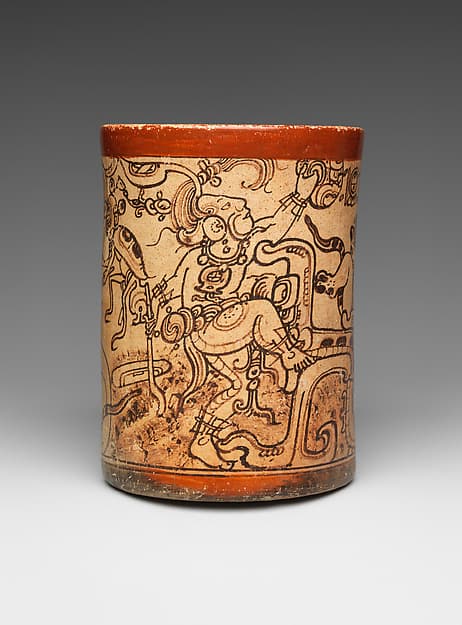
Vessel with mythological scene
Metropolitan Painter
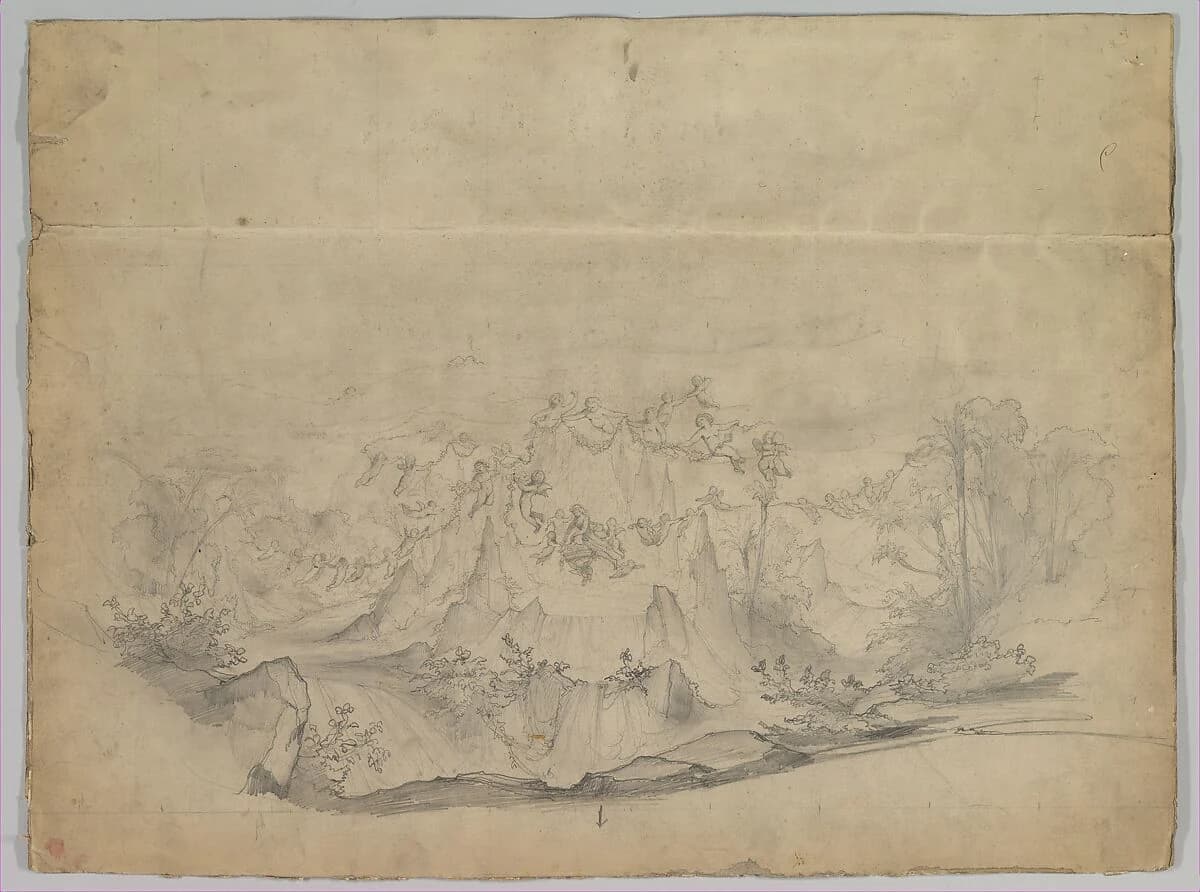
A narrative can take form in a painted vessel, a performed story, a scenic drawing or a costume. Each belongs to its own cultural and material context.
03 / Evidence & interpretation
What research helps us understand
Learning
Memory and alternatives
Future-oriented imagery
Fear and repetitive thought
Social and developmental findings
Imagination can take part in learning. In a 2025 human experiment, imagined pleasant social experiences changed preferences, alongside learning-related activity in the ventral striatum and dorsomedial prefrontal cortex. The researchers modeled an internally generated prediction error. This supports a role for imagined experience in that task; it does not show that imagination releases dopamine identically to real experience, or that ImaginePlus changes brain chemistry. [R01]
Memory and imagination also interact. A review proposes that hippocampal function supports generating alternatives, not simply replaying stored episodes. Controlled work on detailed recollection has found benefits on a particular means-end problem-solving task. Together, these sources support teaching learners to examine detail, compare possibilities, and explain decisions, while leaving broad educational transfer to be evaluated. [R02] [R03]
Future-oriented imagery has been associated with well-being and depressive symptoms, including in a study with a two-month follow-up. The finding invites attention to the content and character of imagined futures. It does not establish vivid optimism as a guarantee of health or as the strongest long-term predictor of well-being. [R05]
Imagery has also been studied in conditioned-fear experiments and clinician-led grief treatment. Those studies concern specific research and treatment contexts; they are not evidence that a creative software platform delivers therapy. Research on repetitive thought likewise shows why imagination cannot be described as uniformly beneficial: sustained worry and rumination depend on content, context, and how thinking unfolds. [R06] [R07] [R08]
Imagining helping another person has increased stated helping intentions in experiments. Pretend-play and narrative interventions with children have produced selected findings concerning emotional control, executive functions, narrative, and literacy. These findings concern particular age groups and measured outcomes, rather than a universal increase in empathy or intelligence. These studies explain part of the educational interest in imagination; the ImaginePlus programs retain their adult scope. [R09] [R10] [R11] [R12]
04 / An educational perspective
Retain possibility as tools develop
Tools help people give an internal possibility an external form. A carved surface, a performed story, a written sketch, and a digital prototype do different kinds of work. Contemporary AI-assisted production introduces another set of possibilities, and another reason to ask whose intention guides the result.
ImaginePlus belongs in this continuing history as a contemporary educational production environment. Its educational purpose is to connect a learner's intention, selected material, revisions, finished work, and explanation. It should help an institution retain the person's reasoning as tools change. This is the program's educational purpose, not a claim that earlier traditions led inevitably to this product.
“All levels of imagination” includes newcomers and experienced practitioners; visual, verbal, sonic, embodied, emotional, and conceptual starting points; and different permitted levels of AI assistance. The page celebrates those differences without claiming to measure imagination on a single scale. In a demonstration, educators can review the supported input modes and the assistance permitted by each activity.
Carry the inquiry into practice
A place for imagination in your curriculum.
ImaginePlus offers two certificate programs that bring intention, production, explanation, and faculty review into one educational pathway. Explore how each level can support your teaching purpose and give distinctive imaginative starting points the time and attention they deserve.
Certificate / Level 1
Creator
A structured foundation for purposeful creative production
Prior exposure to sophomore-level concepts. Up to two minutes of audiovisual work with sound.
Explore Level 1 ↗Certificate / Level 2
Creative Producer
Sustained artistic direction, supported by evidence
Prior exposure to senior-level concepts. One 4:30–5:30 production with collaboration and integrated reflection.
Explore Level 2 ↗For educators, faculty and institutional teams
Give imaginative possibility a place in your institution.
Explore the production workflow, discuss your learners' preparation, and review the evidence and responsibilities for an institution-supported cohort.
Schedule a Demo